

In the brilliant unknown

Greetings and a little update—my exhibition opened two weeks ago and I couldn’t have asked for a better event. About 100+ people showed up and we had lovely conversations about craft and work and finding meaning in the everyday tasks that we can do with our own two hands.


I’ve been woodworking for several years now. Trying to find time to be in the shop, mine or my dad’s, while raising small kids who needed a lot from me.
Being inspired by other people’s furniture and trying to make my own versions.
Grateful for the time I get to spend with my dad, how it’ll never be enough, how very different from him that I am, and just how much we share in common in the shop.
Hours and days and weeks of uncertainty about my skills, my creativity, my ability to work hard enough. Trying to pick myself back up after harsh criticism from others. All my fear of not making a living, of wasting my time in this world of craft, of having nothing of value to say about it.
Through the exhibition, I found my voice.
And it included none of my own woodworking. No charcuterie boards or cabinets or tables. No wood cut by my hand and joined or inlaid.
But it was the story I wanted to tell.


Every other week, I sit at my desk writing these newsletters, telling you about this or that thing I’m working on or thinking about. Carving and shaping words to connect me to you.
My exhibition was a reflection of that kind of craft, that kind of creation. A three-dimensional conversation with people about the meaning of this work, with photos and physical objects alongside text and quotes to guide them through how other craft makers and I see and relate to this world.
This exhibition experience, particularly coming on the heels of being at the Smithsonian’s craft show, have profoundly set my neurons alight. And now I’m once more sitting in the unknown, not sure what is next, but it doesn’t feel intimidating. It feels brilliant.
Over the next several newsletters, I’ll share essays specifically about each theme that the exhibition covered. But first, some background. Below is the write up I did of my show for the brochure. I hope the next couple of weeks find you well and enjoying the change of seasons 💜
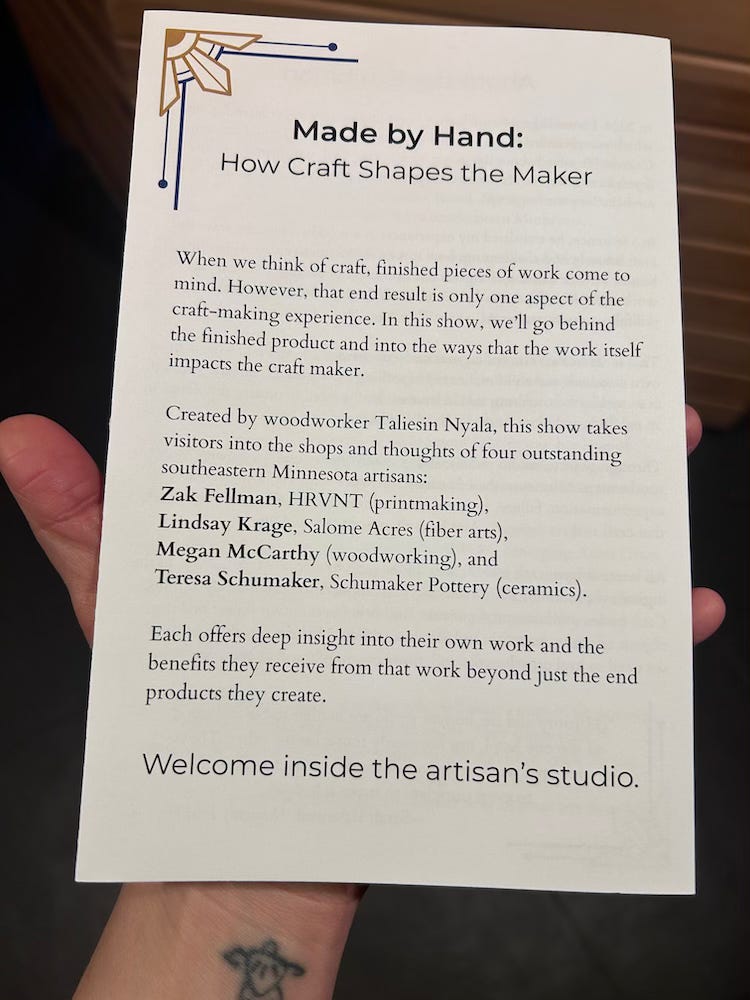
Made by Hand: How Craft Shapes the Maker
In 2024, I attended a series of lectures on Indigenous ways of learning, one of which was given by storyteller Richard Van Camp of the Dene Nation in Canada. He talked about the power of working with your hands and said that if you have craft—be it woodworking, sewing, pottery, painting—you have medicine at your fingertips.
In a sentence, he translated my experiences as a woodworker: the ways that craft is lovely and challenging; how it is an invitation to create something beautiful while existing alongside the likelihood of ruining the materials you work with. A craftsperson dances between these partners, sometimes skillfully, sometimes less so.
That is medicine. The willingness to do the hard work, to build trust in your own standards and abilities, instead of seeking those answers outside yourself, as so much of our culture would have us do. I wanted to present this dance in an exhibition, and so, Made by Hand was born.
Through objects, studio photos, and quotes from my interviews with four southeastern Minnesota-based artisans, this show explores how curiosity, experimentation, failure, reverence, and connection are all essential qualities that craft makers embody. And how all of us have this ability.
All humans have craft inside them. In the push to embrace technology, to embed the digital ever more into our lives, craft is an antidote to algorithms. Craft hones our humanity, patience, and belief in our own skill at making objects of grace, function, and joy. In so doing, I believe it is the medicine we need to heal ourselves through times of struggle and uncertainty.
“[H]istory and the human world are neither stable and good on the one hand, nor hopelessly tragic on the other. They are our own work, so if we want it to proceed well, we have to exert ourselves to make it happen.”
—Sarah Bakewell, Humanly Possible
Artisan panel questions
For the opening, we had an artisan talk. Thought I’d share the questions I asked the artisans—Lindsay Krage, Teresa Schumaker, Megan McCarthy, and Zak Fellman—to see what they bring up for you, too.
1. One of the inspirations for this show came from a lecture I attended with master storyteller Richard Van Camp who spoke of craft as medicine. Can you share a specific moment when your craft served as medicine for you—perhaps during a difficult time or when you needed to reconnect with yourself? How did the physical act of making help heal or ground you?
2. I wrote about craft as dancing between the lovely and challenging—creating something beautiful while existing alongside the likelihood of ruining your materials. How has your relationship with failure and uncertainty evolved in your practice? What has a significant “failure” taught you about your craft and yourself?
3. Each of you works with fundamentally different materials—clay, wood, fiber, ink. How does your chosen medium “speak” to you? What qualities does your material demand of you as a person, and how has working with it shaped who you are beyond the studio?
4. In our increasingly digital world, there’s something radical about choosing to work slowly with our hands. Do you see your craft practice as a form of resistance to our fast-paced, algorithm-driven culture? How does making by hand affirm something essential about being human?
5. I believe all humans have craft inside them. For someone who feels disconnected from their hands or believes they “aren’t creative,” what would you want them to know about beginning a relationship with making? What is the first invitation you’d extend to awaken that dormant craftsperson?